What is the 100K H-1B Proclamation Fee?
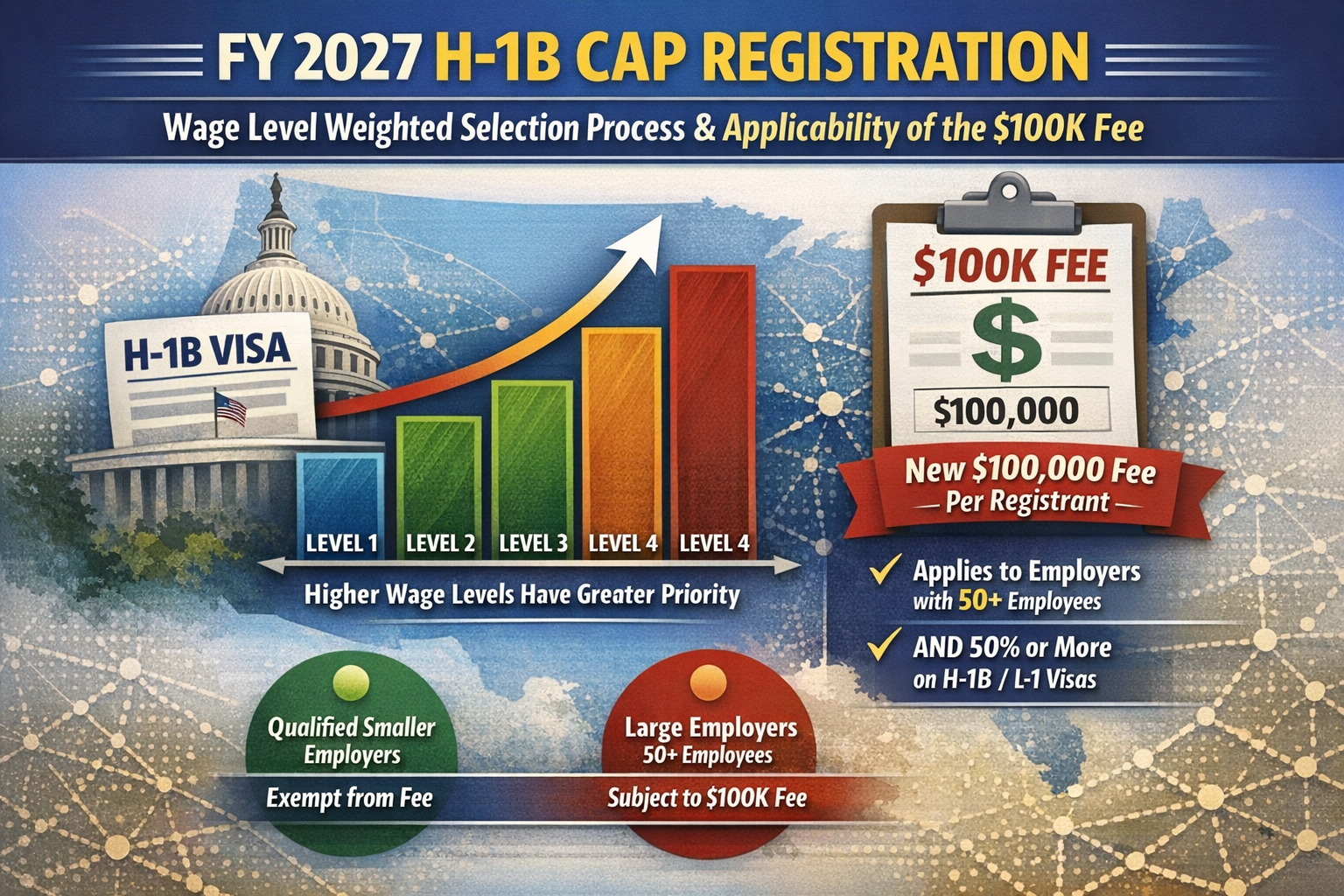
On September 19, 2025, the President issued a Proclamation order under which certain new H-1B petitions filed on or after September 21, 2025 must be accompanied by an additional one-time fee of $100,000. This is in addition to the regular H-1B filing fee.
When does the 100K Proclamation Fee apply?
The $100,000 fee generally applies when:
- The beneficiary is outside the United States and does not have a valid H-1B visa stamping;
- The petition is filed requesting consular notification; or
- USCIS denies the request for a change or extension of status requested and approves the H-1B for consular notification.
Examples of situations when the 100K proclamation applies:
- A candidate is living outside the U.S. without a valid H-1B visa and is applying for a new H-1B after September 21, 2025 (Proclamation date).
- A candidate was previously in the U.S. on H-1B but now is in India without a valid visa, and a new employer files his H-1B after September 21, 2025.
- An employer is filing H-1B after September 21, 2025, requesting consular notification for an employee who does not have a valid H-1B visa stamping.
- An employer has filed H-1B after September 21, 2025 for an employee who does not have a valid H-1B visa, requesting for a change or extension of status which was ultimately denied by USCIS and approved for consular notification.
- An employer who is applying H-1B for its employee through CAP for the first time after September 21, 2025.
- An employee who is applying for a change of employer while outside the U.S. and has no valid H-1B visa stamping.
When does the 100K Proclamation Fee NOT apply?
The $100,000 fee generally does NOT apply when:
- The beneficiary is in the U.S. and USCIS approves Change/Extension of Status i.e., the H-1B is approved with I-94.
- The beneficiary is outside the U.S. but already has a valid and unexpired H-1B visa stamp.
- DHS grants a National Interest Exception (NIE).
Examples of situations when the 100K proclamation DOES NOT apply:
- Any H-1B petition that was filed before September 21, 2025.
- Any H-1B petition that is approved with I-94 (i.e. approved with a change OR extension of status).
- Any H-1B Petition filed on behalf of an employee with a valid H-1B visa stamping.
- Any CAP H-1B petition filed with a request for change of status (eg: from F-1/H-4/L-2/L-1, etc.) to H-1B and approved by USCIS along with the change of status.
- Any student on F-1 OPT whose employer files for CAP H-1B with a request for Change of Status and USCIS approves it.
What is the process of obtaining a waiver in cases where a person is subject to the 100K proclamation?
- File a formal written request for exemption to H1BExceptions@hq.dhs.gov.
- Submit detailed documentation explaining why the case qualifies for a waiver.
- Provide supporting evidence demonstrating national interest, public benefit, or critical need.
DHS will review the waiver request on a case-by-case basis. Approval is discretionary and not automatic. Strong documentation and clear justification are required.
What are the parameters that DHS considers in granting exemption from the 100K proclamation?
DHS generally evaluates whether granting the exemption serves the U.S. national interest. Factors that may be considered include:
- Whether the position supports critical infrastructure or national security.
- Whether the role involves healthcare, public health, or emergency response.
- Whether the beneficiary has specialized skills essential to a high-impact project.
- Whether the employer demonstrates significant economic or public benefit to the U.S.
- Whether denial would cause substantial disruption to a U.S. entity or project.
Each request is reviewed individually. There is no automatic category of exemption unless specifically approved by DHS.
What is the registration period for submitting the FY 2027 H-1B CAP registrations?
For FY 2027, the CAP registration begins at noon Eastern on March 4th 2026 and runs through noon Eastern on March 19th 2026. Registrations must be submitted electronically within the announced time window. Late submissions will not be accepted.
What additional information is required for H-1B CAP FY2027 registration?
For FY2027, USCIS is requiring several new data points that were not part of prior registration cycles. In addition to the standard employer and employee information collected in previous years, registrations must now also include:
- The Department of Labor’s Standard Occupational Classification (SOC) code
- The area(s) of intended employment, meaning the specific worksite location(s)
- The offered salary for the H-1B position
- The corresponding OEWS Wage Level (Level I–IV) that matches the offered salary
How is the FY 2027 H-1B CAP selection process different from previous years?
Until FY 2026, each valid registration was assigned one token per candidate. Once the registration period ended, USCIS would first select 20,000 tokens for candidates who had a U.S. Master’s degree or higher (Master’s CAP). After that, USCIS would select 65,000 tokens from the remaining pool (regular CAP). Under the previous system, if USCIS received 240,000 valid registrations, they would have an equal number of tokens (i.e., 240,000 tokens) in the lottery pool.
Starting FY 2027, USCIS assigns a variable number of entries to each valid registration based on the selected wage level as follows:
- One entry for registrations entered using Wage Level 1
- Two entries for registrations entered using Wage Level 2
- Three entries for registrations entered using Wage Level 3
- Four entries for registrations entered using Wage Level 4
Example (Overall CAP Pool keeping total registrations the same)
Assume USCIS receives 240,000 valid registrations, broken down as follows:
- 40,000 registrations under Level 4
- 30,000 registrations under Level 3
- 40,000 registrations under Level 2
- 130,000 registrations under Level 1
Then the total number of entries entering the lottery system would be:
- (40,000 × 4) = 160,000 entries
- (30,000 × 3) = 90,000 entries
- (40,000 × 2) = 80,000 entries
- (130,000 × 1) = 130,000 entries
Total entries = 160,000 + 90,000 + 80,000 + 130,000 = 460,000 entries
So even though there are only 240,000 registrations, the entry pool becomes 460,000 entries because Level 2, 3, and 4 registrations carry extra entries.
Separate Explanation (Master’s CAP Selection)
For the Master’s CAP, assume USCIS receives 100,000 registrations eligible for the Master’s CAP, split like this:
- 20,000 registrations at Level 1
- 30,000 registrations at Level 2
- 10,000 registrations at Level 3
- 40,000 registrations at Level 4
Then the total number of entries in the Master’s CAP pool would be:
20,000 × 1 + 30,000 × 2 + 10,000 × 3 + 40,000 × 4 = 270,000 entries
Now, USCIS will select MORE THAN 20,000 entries for candidates with a U.S. Master’s degree or higher so that the total number of unique registrations selected equals 20,000 under the Master’s CAP.
After USCIS selects 20,000 unique Master’s CAP registrations, the remaining unselected Master’s CAP registrations will be added to the general pool. After that, USCIS will select enough additional entries from the remaining pool to reach 65,000 unique registrations under the regular CAP.
My employer is based out of California. But I work out of Texas. Which location would be considered for the CAP registration?
Your work location in Texas will be considered for the CAP Registration. The employer’s headquarters location (California) is not a controlling factor unless you actually work there.
My employer wants me to work from multiple locations and pays me Level 2 wage at one location and Level 3 at another location. Which wage level will DHS consider for my CAP selection?
For CAP selection purposes, DHS will consider the lowest wage level listed in the H-1B registration. If an employer lists multiple work locations in the registration and those locations correspond to different OES wage levels, DHS will use the lowest wage level associated with the offered position for CAP ranking. This means that even if one location qualifies for a higher wage level, the presence of a lower wage level at another listed worksite will control the CAP selection.
Example:
- Location A – Level 2 wage
- Location B – Level 3 wage
- Location C – Level 4 wage
In this situation, based on Location A, DHS will treat the registration as a Level 2 wage case for CAP selection purposes.
I work for multiple employers. Employer A is filing my H-1B registration under Level 3 and Employer B is filing under Level 2. Which wage level will DHS consider for my CAP selection?
DHS will consider the lowest wage level among all registrations filed for that beneficiary.
Example:
Employer A → Level 3
Employer B → Level 2
Employer C → Level 4DHS will treat the beneficiary as Level 2 for selection purposes. This means that a lower-wage registration can reduce the benefit of a higher-wage registration filed by another employer.
Can I change the work location or SOC code or Wage level after submitting the CAP registration?
No. Once the CAP registration is submitted, the key details such as the employer, work location, SOC code, and wage level must remain consistent when filing the H-1B petition.
After the CAP H-1B is approved, can an employer file an H-1B amendment for a change of location (or) change in SOC Code (or) to decrease the wage level?
Yes, an Employer can file an H-1B amendment because of the change in the work location or SOC Code. However, the amendment cannot be filed requesting a lower wage level.
My current OPT is expiring on May 10, 2026. Once my name is selected in the lottery, should I file for STEM extension or just rely on CAP-GAP?
It is usually safer to apply for the 24-month STEM extension instead of relying only on CAP-GAP. CAP-GAP extends your work authorization only until April 01, of the subsequent year while the H-1B is pending with USCIS. If the H-1B is not approved by April 01, then the person cannot work until the H-1B is approved. Whereas STEM OPT approval allows the employee to continue working for 24 months.
Is Change of Status (COS) and Extension of Status (EOS) discretionary by USCIS?
Yes. Change of Status (COS) and Extension of Status (EOS) are discretionary. USCIS can approve the H-1B petition itself but still deny the COS or EOS request.
Examples where USCIS can deny the COS or EOS:
- You worked without authorization while on F-1 status. H-1B is approved, but COS is denied.
- A recent DUI or pending criminal case may lead to denial of COS/EOS.
- You overstayed your prior status before filing.
- Misrepresentation or prior immigration violations.
If we submit a registration at one wage level but later discover the prevailing wage data was miscalculated, can we correct it after selection?
No. Registration information generally cannot be corrected after submission.
I am currently working in the U.S. on H-1B for a cap-exempt employer (for example, a university or nonprofit). A for-profit company now wants to sponsor me through the CAP process and file the petition requesting Extension of Status. Will I be subject to the $100,000 Proclamation Fee?
- $100,000 fee generally does not apply, as long as USCIS approves the petition with Extension of Status.
- If USCIS does not grant the requested Extension of Status and approves the petition for Consular Notification, the $100,000 fee will apply.
I hold a valid H-1B VISA from a cap-exempt employer, and I am currently outside the United States. A for-profit employer now wants to file a CAP-subject H-1B petition for me. Will I be subject to the $100,000 Proclamation Fee?
If you are outside the United States with a valid H-1B visa, the $100,000 fee generally does not apply.
Write a Comment